
Adrian Aguilar Life Saving PDA Surgery to Close a Congenital Heart Defect

Shortly after stopping birth control, Cinthia was pregnant. She and her fiancé were over the moon.
Since Cinthia had a previous history of pre-eclampsia, a potentially dangerous pregnancy complication characterized by high blood pressure, her OB-GYN sent her to a maternal fetal medicine specialist.
“My first visit with my MFM didn’t go very well,” said Cinthia. “At 24-weeks, my sugar levels were high. I had to take insulin to control my blood sugar. My blood pressure was fine, but my doctor wanted me to monitor my blood pressure regularly. During that visit, I found out our son had a single umbilical artery in his umbilical cord.”
An umbilical cord contains two arteries and one vein. The vein carries oxygen and nutrients to the baby in the womb, and the arteries remove waste products. Single umbilical artery is when one artery in the umbilical cord is missing. It happens in about 1 in 100 singleton pregnancies (1 percent) and about 5 in 100 multiple pregnancies (5 percent). A single umbilical artery is usually sufficient to maintain a healthy pregnancy, but sometimes it can slow down the baby’s growth and injure other organs.
Cinthia was referred to a fetal cardiologist to check on her baby’s heart. The echocardiograms showed her baby’s heart was perfect and developing normally. Everything seemed to be smooth sailing.
“When I was 33 weeks pregnant, I began having pain and my blood pressure was extremely elevated,” said Cinthia. “My BP was over 200 and they could not get it down. So, I needed an emergency C-section.”
Cinthia and Adrian welcomed their newborn son, Adrian, on August 10, 2022, at a San Antonio hospital. They were happy and excited to meet their newborn baby.
“Our son was small and weighed three pounds,” said Cinthia. “After Adrian was born, he was taken to the NICU and put on oxygen right away. He did well and then he began breathing unusually fast. His tummy would go up and down super fast. He could not bottle feed because of his breathing. It took a lot of effort for him to eat, and his nurses didn’t want him to overdo it. So, he was fed through a NG tube."
Related Content
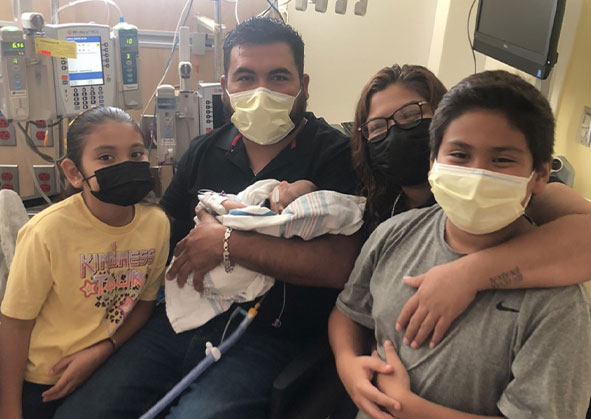 Two unexpected diagnoses
After undergoing several diagnostic tests, including heart ultrasounds and an MRI of his brain, Cinthia learned her son had Tuberous Sclerosis Complex, a rare genetic disorder that causes benign tumors to form in the brain and various organ systems, which can potentially lead to significant health problems as well as developmental delays. Adrian also had a patent ductus arteriosus (PDA), an opening between two major blood vessels leading from the heart. Shortly after birth, the opening closes naturally on its own. But if the PDA remains open, it can cause too much blood to flow into to the baby’s lungs.
“The cardiologist gave my son Motrin for three days but that didn’t close his PDA,” said Cinthia. “Since the hospital didn’t have a (pediatric) cardiovascular surgeon nor a cardiologist that could close Adrian’s PDA, our son was transferred to CHRISTUS Children's. His doctors wanted him to have access to all of the specialists that he needed in one place.
”On September 2, 2022, at three weeks old, Adrian was transferred to CHRISTUS Children's.
Adrian’s life-saving care
Cinthia and Adrian met with Dr. Saleem I. Almasarweh, an interventional pediatric cardiologist, to discuss the heart procedure he would perform on their son to close the PDA.
The procedure, called a transcatheter PDA occlusion, is a minimally invasive, non-surgical procedure to close the ductus arteriosus. During this procedure, a catheter is inserted into the blood vessels of the groin area and navigates through the blood vessels in the heart. Contrast dye is injected through the catheter and X-ray imaging is used to take pictures as the dye moves through the heart. This allows the cardiologist to observe blood flow through the heart to identify cardiac abnormalities. Once the PDA is located, a soft, wire mesh PDA closure device is inserted into the ductus arteriosus artery to block blood flow from the aorta to the pulmonary artery.
On September 8 – the day of Adrian’s PDA occlusion – Dr. Almasarweh took a picture of Adrian’s heart to see how big the PDA was before he installed the device. Adrian’s PDA was too large and too short, and despite attempting several devices, none could be safely placed. The decision was made to discontinue the procedure and Adrian returned to the NICU with complications. Adrian would need heart surgery to close his PDA.
“I broke down and cried,” said Cinthia. “When you hear heart surgery, you think the worst. He was such a tiny fragile baby; how could he undergo heart surgery? It was hard to see my baby have to go through this. I was scared.”
 Adrian’s PDA surgery
Cinthia and her husband met with Dr. Victor Bautista-Hernandez, a cardiothoracic surgeon, who explained how he would close their son’s PDA. The next day, Dr. Bautista-Hernandez performed a PDA ligation at Adrian’s bedside.
“Dr. Bautista told me he wouldn’t have to open up my son’s breast bone,” said Cinthia. “Instead, he made an incision in the area underneath my son’s armpit. He was able to see the PDA through the tiny incision and closed it with a suture. Immediately after the procedure, my son’s breathing improved significantly.”
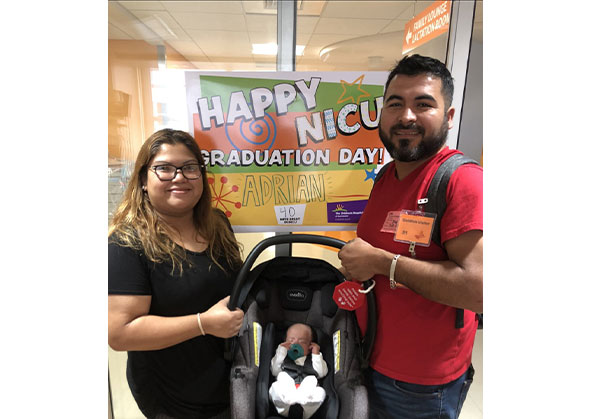
While Cinthia and her fiancé were relieved their son’s surgery went well – it was hard seeing him recover from the procedure. After spending an additional 17 days in the NICU, Adrian was ready to go home.
Adrian today
Today, 2-month-old Adrian is a healthy baby. He is growing, he moves around a lot, and he is eating well. He also loves being the center of attention. His older siblings adore their little baby brother.
“I am amazed by Adrian’s progress,” said Cinthia. “Our family is thankful we were sent to The Children’s Hospital of San Antonio where our son received the life-saving surgery he needed. Dr. Almasarweh and Dr. Bautista were amazing and took the time to explain everything to us. They were invested in my son’s outcome and wanted the very best for him. They helped calm our fears. The NICU nurses were great. They were always there when we needed them. They took great care of Adrian. They were on top of everything."
As part of Adrian’s follow-up care, he sees his pediatric cardiologist to ensure his heart is functioning normally. Adrian also sees his pediatric neurologist, Dr. Jose Aceves, regularly to monitor his Tuberous Sclerosis Complex. Adrian has a few benign tumors, but he hasn’t had any seizures. Dr. Aceves will continue to monitor the tumors to ensure nothing changes.
For more information about our Interventional Cardiology Program at CHRISTUS Children's, please visit this web page: Pediatric Cardiology & Heart Care | CHRISTUS Health.
CHRISTUS Genetics Clinic
CHRISTUS Children's has a monthly Prader-Willi syndrome multidisciplinary clinic based in San Antonio, Texas. If you or your child has a confirmed diagnosis of Prader-Willi, you can be referred to the clinic to receive coordinated care from our experienced specialists, including geneticists, ENT doctors, endocrinologists, pulmonologists, sleep medicine specialists, psychologists, dietitians, social workers, and speech pathologists.
Visit CHRISTUS Genetics Clinic

