
Thomas Milner: 103 Days in the NICU
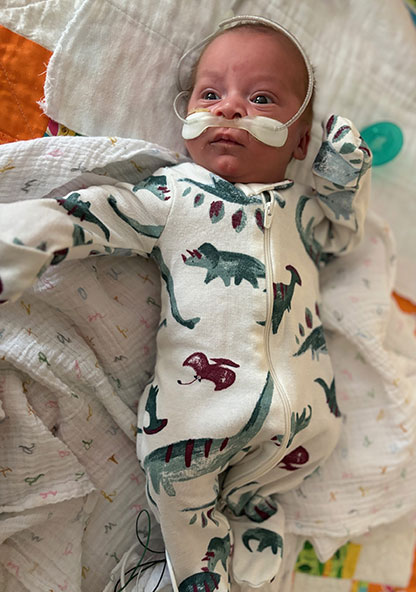
Nicole Milner still vividly remembers the moment she saw those two pink lines emerge on her pregnancy test. It was like a rollercoaster ride of excitement and nerves all at once!
My husband, Mason, and I were living in Montana at the time,” said Nicole. "He was in the Air Force, so we were stationed up there. It was about a month before we moved back to Texas, and it was the day after Mother’s Day when I just felt something was off. I took a pregnancy test and couldn’t believe it.
Despite Mason being miles apart due to work obligations, Nicole couldn't contain her excitement and shared the news with him over the phone. "We were definitely excited," she said.
Pregnancy journey
Nicole's pregnancy started smoothly as she managed bouts of morning sickness and fatigue. Regular checkups with her OB-GYN, Dr. Angela Akonye , affiliated with CHRISTUS Children’s, were reassuring. Thomas consistently measured in the 50th percentile during ultrasounds, indicating healthy growth.
During my first trimester, it was uneventful--I just felt more tired than usual,
recalled Nicole. In the second trimester, I began seeing a maternal-fetal medicine (MFM) specialist due to my hypothyroidism, which categorized me as a higher-risk pregnancy.
Nicole had two MFM appointments, the first during the 21-week anatomy scan and another scan one month later. Everything looked great with Thomas.
Then, around the 25-week mark, Nicole began experiencing troubling symptoms.
About two weeks before Thomas was born, I started feeling off,
said Nicole. I initially thought it was just anxiety or heartburn, assuming it was related to my baby's growth and everything shifting around. However, it turned out to be something far more serious.
During her OB-GYN appointment, Dr. Akonye examined Nicole’s glucose levels and suggested over-the-counter remedies for heartburn, but they provided no relief. A week later, she consulted with her MFM specialist.
By then, the pain had intensified, occurring nightly like clockwork. Nicole experienced severe chest and upper back pains, finding minimal relief only by lying on a heating pad and taking Tylenol. Her blood pressure showed a slight elevation, prompting further tests, including blood work and a urine test. A few days later, Nicole received a call from her MFM specialist with the results from her lab work.
Elevated blood pressure, protein in the urine, and abnormal liver enzymes led to the diagnosis of HELLP syndrome, a rare form of preeclampsia. The MFM contacted Dr. Akonye, and they recommended Nicole be admitted to CHRISTUS Children’s for immediate care to ensure the safety for her and her baby.
HELLP Syndrome
HELLP syndrome is a rare but serious pregnancy complication that can threaten the health of both the mother and baby. The acronym stands for Hemolysis (the breakdown of red blood cells), Elevated Liver enzymes, and Low Platelet count. Symptoms may include nausea, headache, upper abdominal pain and swelling.
Treatment for HELLP syndrome typically involves hospitalization and close monitoring of both the mother and the baby. Depending on the severity of the condition and how far along the pregnancy is, treatment may include:
- Delivery: In many cases, delivery of the baby is the most effective treatment. This is often necessary, even if the pregnancy is not yet full term, to prevent further complications. To the mother and baby.
- Medications: Medications may be administered to help manage symptoms and prevent complications. These may include medications to lower blood pressure, prevent seizures (if preeclampsia is also present), and improve liver function.
- Blood transfusions: If there is a significant blood loss or a severe drop in platelet count, a blood transfusion may be necessary to restore blood cell levels.
- Steroid injections: Steroids may be given to help accelerate lung development in the baby if preterm delivery is necessary.
Treatment for HELLP syndrome is typically individualized based on the specific circumstances of each case, and the goal is to manage the condition and its complications while ensuring the best possible outcome for both mother and baby.
Children's NICU
CHRISTUS Children's NICU
The Level IV NICU at CHRISTUS Children's in San Antonio offers advanced care for newborns and their families, especially babies born prematurely or with special medical conditions.
Thomas' Early Arrival
Once admitted to CHRISTUS Children’s, Nicole was put on a magnesium sulfate drip to stabilize her blood pressure and prevent seizures, both potential complications of HELLP syndrome. Additionally, she received blood pressure medication administered via IV to further manage her condition.
That night, Dr. Cody Henderson, the neonatologist, explained the procedures they would undertake when Thomas was born, outlining the potential risks and his chances of survival given his gestational age. Discussions centered around feeding options, emphasizing the benefits of breast milk over formula for a premature baby.
Despite some improvement in my blood pressure, I still had headaches and nausea, classic symptoms of HELLP syndrome,
Nicole explained. The doctors closely monitored my condition to determine the best time to deliver Thomas, while I received steroid shots to boost his lung development. Dr. Akonye advised against additional medication because headaches that won’t go away are a symptom of HELLP syndrome and she didn’t want to risk potentially masking a symptom and risking our health in the process. In the end, we decided on an emergency Cesarean to prioritize the safety of both the baby and myself.
On October 25, 2023, Nicole and Mason were filled with joy as they welcomed their precious son, Thomas, into the world. Despite the early arrival, Thomas made his presence known with a tiny cry, filling their hearts with both relief and apprehension. Born at just 27 weeks, weighing a mere 2 pounds, 2 ounces, Thomas was sent to the NICU, where his journey began.
In the NICU, he received an umbilical line for medications and respiratory support, initially on a CPAP,
said Nicole. While my husband saw him within hours, I couldn't see him for over 24 hours due to the magnesium drip I was on after delivery. When I finally got to see him, I cried every time. It was incredibly hard, seeing him so fragile. His sensitive skin made even gentle touches feel like a sunburn. We could only do 'hand hugs' every few hours. Thomas was on a feeding tube, but thankfully, he was doing well.
Thomas was intubated three days after birth and remained so until right before Thanksgiving, when he was finally extubated.
While in the NICU, Thomas was diagnosed with a heart condition known as patent ductus arteriosus (PDA). In PDA, a blood vessel called the ductus arteriosus fails to close shortly after birth, resulting in an abnormal passage between the aorta and the pulmonary artery. This can lead to mixing of oxygen-rich and oxygen-poor blood causing circulation issues and placing strain on the heart. Thomas was placed on medications in an attempt to close his PDA, but ultimately surgical intervention was needed due to the size of the defect. On December 1, 2023, Dr. Victor Bautista-Hernandez performed heart surgery on 1-month-old Thomas.
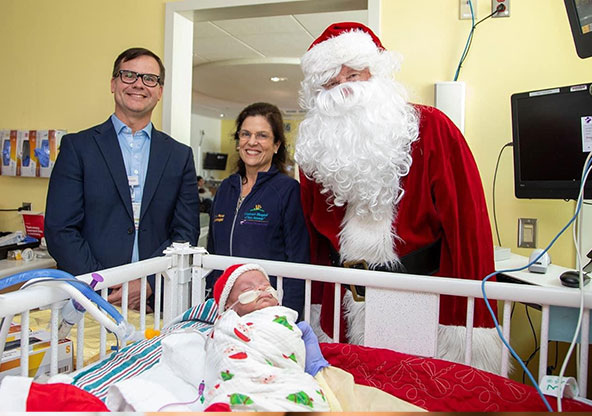
As Thomas’ strength grew, so did the hope of bringing him home. But, setbacks delayed their reunion.
It was an emotional rollercoaster,
Nicole said. But we held onto hope, knowing that each day brought him closer to us.
After 103 days in the NICU, Thomas beat the odds. By the time he left the NICU on February 5, 2024, he could breathe on his own, his heart was stable, and his bottle feedings had improved significantly.
The doctors and nurses were amazing,
said Nicole. They felt like family, especially since we were there for quite a while. Thomas was a NICU celebrity! Dr. Akonye was fantastic throughout the pregnancy and afterward. She made sure I was doing well. I believe her quick thinking probably saved both of us.
Thomas Today
Now at 4 months old, Thomas is thriving. He now weighs in at 11 pounds.
He’s our little Velcro baby,
Nicole chuckled. He adores being held and swinging in his swing. His four- legged ‘cat siblings’ are adjusting to sharing the spotlight with him. He’s also quite the eater. It seems like he wanted an October birthday, just like his mom.
As for follow-up care, Thomas sees his CHRISTUS Children’s pediatrician, Dr. Emily Quini, and his cardiologist, Dr. Govinda Paudel regularly. He also has follow-up appointments with specialists in the developmental clinic to monitor his progress and address any potential developmental delays common in premature infants.
