
Cavernous Angioma in Children: Maddox's Brain Surgeries and Recovery at CHRISTUS Children's
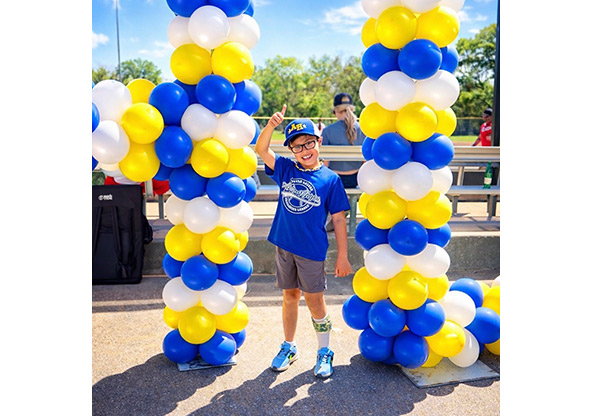
Maddox was a healthy, active 5 year old, riding his bike, playing basketball in the driveway and enjoying life like any other child his age. He had no prior health concerns, no warning signs, nothing to suggest that his life was about to change.
But in early February 2024, something wasn’t right. His parents, Raven and Christopher Perez, began noticing unusual, involuntary movements in his left arm, where it would lift and become stuck behind his head. The symptoms appeared suddenly and were completely out of character.
Within days, she took him to the emergency room.
A CT scan revealed a brain bleed caused by a mass.
Because the initial hospital did not offer pediatric neurosurgery services, Maddox was urgently transferred to CHRISTUS Children's.
From that point on, it felt like a tornado,
Raven said. Everything was happening so fast.
Early Signs of Brain Bleed in Children
The next day, Maddox’s family met Dr. Mark Lee, division chief of neurosurgery at CHRISTUS Children’s, who would lead his care.
After advanced imaging, Maddox was diagnosed with a cavernous angioma, a cluster of abnormal blood vessels in the brain that can leak or bleed.
In Maddox’s case, the lesion had already bled, causing stroke-like symptoms and the sudden involuntary movements his family had noticed.
What made his case especially complex was where the mass was located.
Measuring approximately three centimeters, the cavernous angioma sat deep within Maddox’s brain in the midbrain near the ventricular system, an area responsible for consciousness, motor control and critical neurological pathways. Its location made treatment especially complex and required a highly specialized surgical approach.
Surgery was the only option.
Neurosciences Center
CHRISTUS Children's Neurosciences Center
The Neurosciences Center at CHRISTUS Children's in San Antonio offers expert, compassionate care for a wide range of neurosurgical procedures and neurological conditions including autism and epilepsy. Our experts work together to provide your child with a tailored treatment plan for comprehensive care.
Pediatric Brain Surgery for Cavernous Angioma
To reach the mass, Dr. Mark Lee performed a craniotomy, temporarily removing a portion of the skull to access the brain and reach the lesion deep within the midbrain.
Our goal is to remove as much of the lesion as possible while protecting surrounding brain tissue,
Dr. Lee said. In Maddox’s case, removing the entire mass carried significant risk due to its location, so we focused on safely reducing the lesion and relieving the pressure caused by the bleed..
The procedure lasted approximately six hours. While much of the mass was removed, a small portion was intentionally left behind to avoid damaging critical brain structures.
Before surgery, Raven explained the moment to her son in a way he could understand. Because he loved football, she framed it in terms of a game.
I told him he was going to go to sleep and the doctors were going to look at his brain and fix everything,” she said. “And this was going to be his championship game. He had to play hard and fight hard—but he was going to win, just like he always wins his games.
Maddox’s first surgery took place on February 14, 2024, on Valentine’s Day.
Complications After Brain Surgery in Children
Although the operation itself was successful, his recovery was far more complex than expected.
He did not wake up for nine days.
Because the surgery involved an area of the brain responsible for consciousness, his brain needed time to recover. During that time, his family waited—day by day—for signs he would wake up.
Complications followed.
Over the next 30 days, Maddox underwent four brain surgeries:
- Removal of the cavernous angioma
- Drainage of fluid after developing hydrocephalus
- Placement of a shunt to manage fluid buildup
- Placement of a catheter to correct shunt complications
Every day I asked, ‘Is he going to wake up today?’” Raven said. “I didn’t want to leave his side.”
After the fourth surgery, his condition finally began to improve.
Rehabilitation After Pediatric Brain Surgery
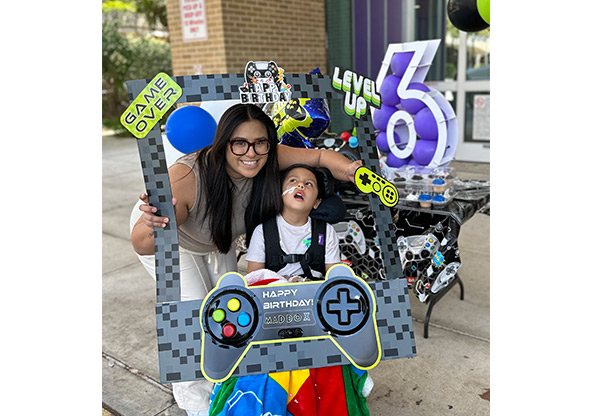
When Maddox became more alert, the reality of his condition set in.
He could not walk.
He could not talk.
He could not eat or swallow.
What began as a life-saving surgery became a long and uncertain journey to recovery.
After stabilizing, Maddox was transferred to inpatient rehabilitation at CHRISTUS Children's, where a multidisciplinary team began working with him daily, including rehabilitation physicians Dr. Donald Currie and Dr. Laura Wilner. Dr. Wilner serves as division chief of Physical Medicine & Rehabilitation and medical director of the Acute Inpatient Rehabilitation Program at CHRISTUS Children’s.
Before therapy could begin, Maddox had to reach a critical milestone—staying awake long enough to participate.
“That alone was a huge moment for us,” Raven said.
Once ready, Maddox began three intensive therapy sessions each day, including physical therapy to rebuild strength and mobility, occupational therapy to relearn everyday tasks and speech therapy to restore communication and swallowing. Progress started at the most basic level.
“At first, it was just, ‘Can he sit up for one minute?’ That was a win,” Raven said.
Even simple reflexes had to be retrained.
“They would put ice on his lips just to get him to close them. That’s how far back we were starting.”
For weeks, Maddox was completely nonverbal. Then one day, everything changed.
“He looked at me and said, ‘Mom,’” Raven said. “It felt like hearing his first words all over again.”
From there, progress built slowly—single words, then short phrases, then conversation. Over time, his strength and coordination began to return. By the time he was discharged, Maddox could sit up independently, take steps with assistance, speak in short phrases and had begun eating again.
“There was a time we didn’t know if he would ever walk or talk again,” Raven said. “The therapists made that possible.”
Throughout his hospital stay, his care team at CHRISTUS Children’s became like family.
“It wasn’t just the doctors,” Raven said. “It was the therapists, nurses and everyone we encountered. Every single person had an impact on our journey.”
Life After Pediatric Brain Surgery
Maddox was discharged on Mother’s Day after spending 90 days in the hospital.
Going home was emotional—but also overwhelming.
After 90 days in the hospital, Maddox went home in a wheelchair, with new medical needs and a completely different daily routine.
Inside the hospital, Raven had constant support. Nurses and care teams were just steps away whenever she had a question or needed help. At home, that safety net was gone.
“At the hospital, if something didn’t feel right, I could just step outside the room and call a nurse,” she said. “At home, it was on us.”
While the team at CHRISTUS Children's provided extensive training, equipment, care coordination and guidance for school accommodations, nothing could fully prepare them for the reality of navigating this new life on their own.
Maddox also faced ongoing physical challenges after discharge. He continues to experience weakness in his left arm and leg, wears a brace on his left ankle and foot and spent months participating in outpatient physical, occupational and speech therapies as part of his recovery journey.
As part of his physical recovery, Maddox was later diagnosed with an intellectual developmental disability (IDD), affecting his processing speed and cognitive function. But even with these challenges, his progress has continued to move forward.
Long-Term Recovery and Follow-Up Care
Today, Maddox continues follow-up care with his team, including neurosurgery, neurology, rehabilitation medicine and neuropsychology. After experiencing seizures during his hospitalization and remaining on medication for a year following discharge, he is now seizure-free, off medication and transitioning to annual visits.
Over time, he has made remarkable progress and no longer relies on a wheelchair to get around.
A year after surgery, he joined a special needs Little League team, running the bases with confidence.
“He’s a chatterbox now. He’s hilarious,” Raven said. “I’m so proud of how far he’s come.”
Support for Families Facing Pediatric Brain Conditions
After spending months in the hospital, Raven felt called to give back. Today, she serves on the Family Advisory Board at CHRISTUS Children's, helping support other families navigating similar experiences.
“I wanted to be the bridge between the hospital and families. There are so many resources—you just don’t always know what to ask for.”
For families facing the unknown, she shares this message:
“You may not have all the answers right now. The recovery may not look how you expect. But don’t give up. Don’t lose hope. Just keep loving your child—it gets better.”
From a sudden diagnosis to four brain surgeries in 30 days and a fifth surgery later that year, to relearning how to walk and talk, Maddox has faced more than most ever will.
And through it all, he never stopped fighting.
A resilient boy who taught everyone around him the true meaning of perseverance.
“I told him before surgery to play the game and win—and he did,” his mom said. “But more than that, he showed us all just how strong and resilient he truly is.”
